FOUNDING (1865)
Liberty Baptist Church was organized on June 13, 1865, by a group of freed Black individuals who had migrated northward from the South following the Civil War's end, establishing it as Evansville's first independent African-American Baptist congregation. This formation reflected a deliberate effort among former slaves to create autonomous spaces for worship, separate from white-controlled churches, amid the era's social upheavals and emancipation's immediate aftermath. Initial gatherings occurred in a small brick building at the corner of Chestnut and Canal Streets, underscoring the community's resourcefulness in utilizing modest, pre-existing structures for religious assembly.
The church's establishment coincided with significant post-war migration patterns, as hundreds of Black individuals crossed the Ohio River into Evansville in 1865, drawn by opportunities in the city's burgeoning industrial economy and relative proximity to southern states.This influx contributed to a rapid swell in Evansville's Black population, from 95 residents in 1860 to nearly 2,000 by 1870, enabling the congregation's quick organizational momentum despite lacking formal institutional support. Leadership initially included Black deacons and members, with Colonel Woods—a white advocate for former slaves—serving as the first pastor, highlighting early interracial elements in pastoral roles while the core membership drove self-sustained community formation.
As the oldest extant African-American congregation in Evansville, Liberty Baptist exemplified bootstrapped resilience, with members pooling limited resources to formalize their spiritual independence in an environment of economic precarity and racial transition. Historical records from the National Register of Historic Places nomination affirm this founding as a pivotal act of agency by freed people, prioritizing doctrinal autonomy and communal solidarity over dependence on established denominations.
Early Development and Community Formation (1866–1885)
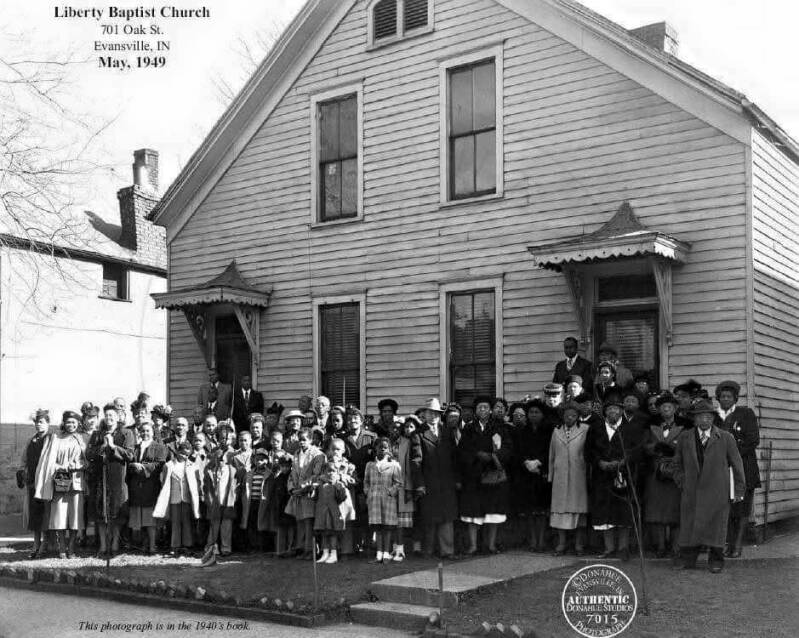
Following its organization on June 13, 1865, by newly freed African Americans migrating northward after emancipation, Liberty Baptist Church experienced initial consolidation and expansion in Evansville's burgeoning black community. In 1866, the congregation constructed a modest frame structure measuring 40 by 50 feet at the corner of Seventh and Oak streets (now Martin Luther King Jr. Boulevard and Oak Street), providing a dedicated space for worship after initial gatherings in a small brick building at Chestnut and Canal streets. This development coincided with rapid demographic growth, as Evansville's African American population surged from 95 residents in 1860 to nearly 2,000 by 1870, driven by migration from southern states seeking economic opportunities in the Ohio River valley. The church's early stability attracted further arrivals through personal networks, enabling organic membership increases without formal proselytizing campaigns.
By the late 1870s and early 1880s, Liberty Baptist had emerged as Evansville's largest African American congregation, reflecting its appeal as a focal point for spiritual and communal organization amid persistent racial barriers to mainstream institutions. Leadership transitions, such as the arrival of J.D. Rouse—a former slave who joined in 1865 and assumed the pastorate in 1882—bolstered internal cohesion and directed resources toward sustainability. In 1880, the frame building was replaced with a brick edifice at the same site, signaling financial self-sufficiency derived from member contributions and underscoring the congregation's emphasis on internal mutual aid over dependence on external philanthropy. These efforts cultivated resilience, with the church functioning as an autonomous hub for education, dispute resolution, and economic cooperation, countering discrimination through collective resource pooling rather than appeals for outside intervention.
The church's location catalyzed the formation of the surrounding Baptist Town neighborhood, where successive waves of black migrants settled in proximity, drawn by the institution's role as a social anchor. This clustering fostered tight-knit networks predicated on familial and associational ties, transforming a peripheral urban area into a self-contained enclave by the mid-1880s. Community formation emphasized practical interdependence—such as shared labor for home construction and informal lending circles—enabling households to navigate wage labor in industries like river transport and manufacturing without systemic subsidies. Liberty Baptist thus exemplified causal pathways from individual migration to communal solidification, prioritizing endogenous support structures that sustained viability in an environment of legal and social exclusion.
Building Construction and Expansion (1886–1950s)
"In June 1886, a cyclone destroyed the church's existing brick structure, which had been built in 1880 at a cost of $10,000 to serve a rapidly expanding congregation of former slaves and their descendants.[4] The disaster prompted immediate rebuilding efforts on the same site at 701 Oak Street, with construction of a new red brick edifice commencing shortly thereafter as a demonstration of the members' "zeal and devotion."[4] The replacement building, completed in time for its first service in December 1886, cost $19,000 and was financed primarily through congregational subscriptions supplemented by outside donations, underscoring the community's sacrificial contributions amid post-Civil War economic constraints.[4]
The 1886 structure adopted a Gothic Revival style, featuring a rectangular layout three bays wide by seven bays deep, with a prominent projecting entrance tower, lancet-arched windows, buttresses, and restrained ornamental brickwork and limestone accents suited to the practical demands of Baptist worship gatherings.[4] This design prioritized functional capacity for increasing attendance over elaborate symbolism, aligning with the denomination's emphasis on doctrinal preaching and communal fellowship rather than ornate ritualism.[4] The building's listing on the National Register of Historic Places in 1978 recognizes its architectural integrity and role in local Black religious history, with the period of significance centered on 1875–1899 and the pivotal year of 1886.
Through the early to mid-20th century, the facility underwent no major expansions documented in historical records, relying instead on its original capacity to handle membership growth tied to Evansville's industrial expansion and migration patterns.[4] Basic maintenance addressed wear from urban environmental changes, preserving the structure's core form for sustained use in services and community functions until post-1950s developments.[4]
Original Structure and Design Features.
The Liberty Baptist Church's original structure, completed in 1886 following the destruction of a prior brick edifice by a cyclone on June 9, 1886, consists of a rectangular red brick building measuring three bays wide by seven bays deep and one story in height, situated at the eastern corner of 7th and Oak Streets in Evansville, Indiana. The design adheres to Gothic Revival principles with eclectic Neo-Jacobean influences, featuring a dominant central projecting tower on the north facade that houses the primary entrance, flanked by lancet windows with pointed arches and side entrances in the end bays. Exterior ornamentation includes buttress forms framing the bays, re-entrant corner buttressing on the tower, limestone details such as engaged pinnacles and moldings (many painted over time), and brickwork patterns like mouse-tooth diapering, corbelling, and a molded water table, all contributing to a steeply roofed mass evoking modest English parish churches suited to an industrial-era community setting.
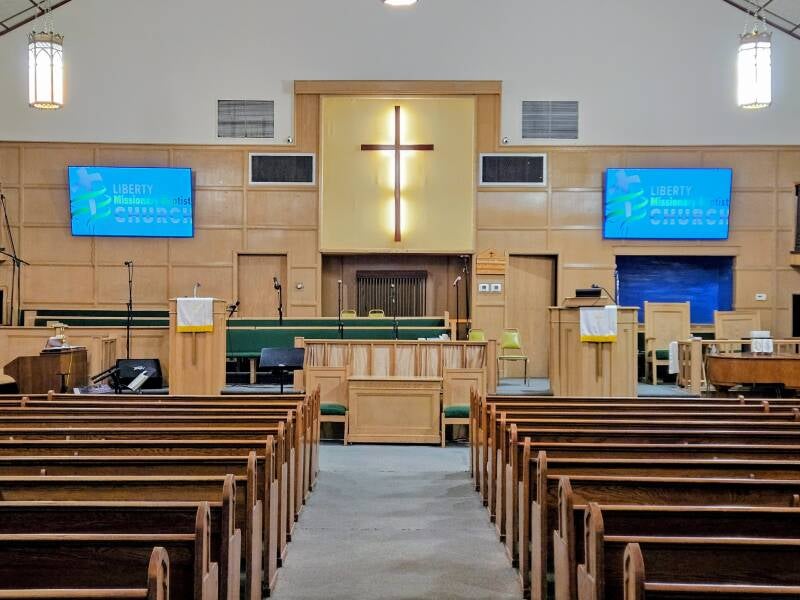
Internally, the original layout centered on a sanctuary oriented for worship, with lancet-profiled windows providing natural light and original stained glass elements, though subsequent alterations shortened the space by one bay and added contemporary paneling to prioritize functional use over elaborate decoration. This configuration reflects Baptist emphases on scriptural centrality, evident in the absence of iconographic excess and focus on durable, unadorned communal assembly, as documented in architectural assessments.
The structure's design holds architectural significance for its adaptive nineteenth-century synthesis of Gothic pointed arches and buttresses with practical brick construction, listed on the National Register of Historic Places in 1978 for embodying post-Civil War community resilience without ornate excess.Additions and Renovations In 1959, Liberty Baptist Church added an education wing to its facilities at 701 Oak Street, expanding capacity for classrooms and instructional activities to accommodate the congregation's growth following post-World War II migration and community expansion in Evansville's Baptisttown neighborhood.This brick addition, positioned adjacent to the original 1886 Gothic Revival structure, addressed practical needs for enhanced religious education and youth programs, reflecting the church's emphasis on literacy and moral development as foundational to community self-reliance. A limestone-faced addition constructed in 1965 housed church offices, Sunday School rooms, and meeting and dining facilities.